
Understanding Laboratory Measurement Accuracy
Accurate measurements are essential for repeatable and trustworthy scientific results. Even small deviations can lead to incorrect conclusions, wasted materials, or unsafe outcomes.
Why Precision Matters in Scientific Work
Precision ensures consistency. In pharmaceutical research, a tiny error in volume can change drug potency. In chemistry, incorrect measurements can affect reaction rates or yields. This is why choosing the right measuring tool matters so much.
Accuracy vs Precision: A Simple Explanation
-
Accuracy means how close a measurement is to the true value.
-
Precision means how consistent repeated measurements are.
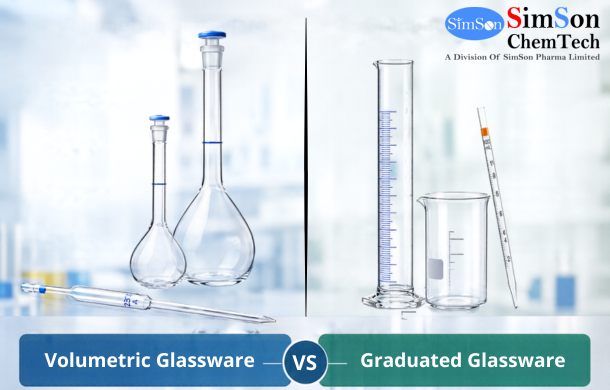
The debate of Volumetric vs Graduated Glassware: Which Is Better for Precision Work? largely comes down to how these tools balance accuracy and repeatability.
What Is Volumetric Glassware?
Volumetric glassware is designed to measure a single, exact volume with extremely high accuracy.
Common Types of Volumetric Glassware
Volumetric Flasks : Volumetric flasks are used to prepare standard solutions. Each flask has a single calibration mark indicating one precise volume, such as 100 mL or 1 L.
Volumetric Pipettes : Volumetric pipettes deliver one fixed volume, such as 10 mL or 25 mL, with minimal uncertainty. They are a gold standard in analytical labs.
How Volumetric Glassware Is Calibrated
Volumetric glassware is typically calibrated to contain (TC) or to deliver (TD) a specific volume at a set temperature, usually 20°C or for tropical countries.. This strict calibration process ensures unmatched precision.
What Is Graduated Glassware?
Graduated glassware measures a range of volumes, marked by a series of lines along the container.
Common Types of Graduated Glassware
Graduated Cylinders : Graduated cylinders are versatile and easy to use. They measure various volumes but are less precise than volumetric flasks or pipettes.
Burettes and Measuring Pipettes : Burettes are commonly used in titrations, allowing controlled delivery of liquid. Measuring pipettes offer flexibility but sacrifice some accuracy.
Calibration and Measurement Range
Graduated glassware is calibrated across a scale, which introduces more room for reading errors and variation.
Volumetric vs Graduated Glassware: Key Differences
Understanding the practical differences helps answer Volumetric vs Graduated Glassware: Which Is Better for Precision Work?
Precision and Accuracy Comparison
-
Volumetric glassware: Extremely high accuracy and precision
-
Graduated glassware: Moderate accuracy, suitable for approximate measurements
Volumetric tools often have tolerances as low as ±0.02 mL, while graduated tools may vary by ±0.1 mL or more.
Ease of Use and Flexibility
Graduated glassware allows multiple measurements with one tool, making it faster for routine tasks. Volumetric glassware is more specialized and slower but more reliable.
Cost and Durability Considerations
Graduated glassware is usually cheaper and more durable. Volumetric glassware costs more due to tighter manufacturing standards and careful calibration.
Which Glassware Is Better for Precision Work?
The answer depends on the application.
Best Choice for Analytical Chemistry
For quantitative analysis, standard solution preparation, and high-stakes experiments, volumetric glassware is clearly superior. Its design minimizes uncertainty and human error.
Best Choice for Educational and Routine Labs
Graduated glassware is ideal for teaching labs, quick measurements, and situations where slight variation is acceptable.
According to laboratory best practices published by organizations like ISO and NIST, volumetric tools are recommended for reference measurements and calibration standards (see: https://www.nist.gov).
Common Measurement Errors and How to Avoid Them
Even the best glassware can give poor results if used incorrectly.
-
Always read the meniscus at eye level
-
Ensure glassware is clean and residue-free
-
Use the correct temperature conditions
-
Never interchange volumetric and graduated tools for critical steps
Frequently Asked Questions (FAQs) - About Volumetric and Graduated Glassware
1. Is volumetric glassware always more accurate?
Yes, volumetric glassware is designed specifically for maximum accuracy at a single volume.
2. Can graduated cylinders be used for precise work?
They can be used for semi-precise tasks, but not for analytical-grade measurements.
3. Why do volumetric flasks have only one mark?
This ensures the volume is exact, reducing reading and interpretation errors.
4. Are plastic versions as accurate as glass?
Plastic is generally less accurate due to expansion and manufacturing limits.
5. At what temperature are volumetric wares Calibrated?
Most volumetric glassware is calibrated at 20°C.
6. Which lasts longer: volumetric or graduated glassware?
Graduated glassware tends to be more durable, while volumetric glassware requires careful handling.
Final Verdict: Choosing the Right Glassware
When deciding Volumetric vs Graduated Glassware: Which Is Better for Precision Work?, the answer is clear for high-accuracy tasks. Volumetric glassware offers unmatched precision and reliability. Graduated glassware provides flexibility and convenience for everyday laboratory use.
Conclusion
Precision work demands the right tools. Volumetric glassware stands out for accuracy, consistency, and scientific reliability, while graduated glassware excels in versatility and efficiency. Understanding their differences allows scientists, students, and technicians to make informed choices and achieve dependable results every time.