
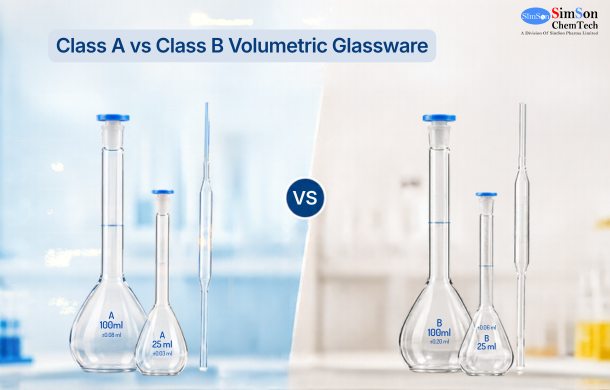
What's the Difference and Why It Matters
Class A volumetric glassware has tighter tolerance limits and is individually certified for high-precision work like analytical chemistry, pharmacopeial testing, and regulated QC labs. Class B glassware has roughly double the tolerance of Class A, costs less, and is suited to routine, non-critical lab work such as teaching labs, general prep, and bulk dilutions.
If you've ever picked up two nearly identical volumetric flasks and wondered why one costs twice as much as the other, the answer usually comes down to one letter stamped on the glass: A or B. That single marking tells you how accurately the piece was manufactured and verified — and it can make or break your data's compliance with pharmacopeial or ISO standards.
This guide breaks down exactly what separates Class A and Class B volumetric glassware, how tolerances are defined, and how to decide which class your lab actually needs.
What Is Volumetric Glassware Classification?
Volumetric glassware — flasks, pipettes, burettes, and measuring cylinders — is manufactured to deliver or contain a specific volume of liquid within a defined margin of error. That margin of error is the tolerance, and it's what the "Class A" or "Class B" designation refers to.
These classifications are governed by international standards, most commonly:
● ISO 1042 (volumetric flasks)
● ISO 385 (burettes)
● ISO 648 (single-volume pipettes)
● DIN 12664 / DIN 12691 (equivalent German standards, widely referenced alongside ISO)
Each standard specifies the maximum permissible deviation from the stated volume, based on the glassware's nominal capacity.
Class A vs Class B: The Core Differences
|
Feature |
Class A |
Class B |
|
Tolerance |
Tight (e.g., ±0.10 mL on a 100 mL flask) |
Roughly 2x Class A (e.g., ±0.20 mL on a 100 mL flask) |
|
Certification |
Individually tested and marked; often batch-certified with a certificate of conformity |
Typically not individually certified |
|
Typical use |
Regulated, analytical, pharmacopeial, and referee testing |
Routine lab work, teaching, general-purpose prep |
|
Cost |
Higher |
Lower |
|
Material |
Usually low-expansion borosilicate glass (e.g., Boro 3.3) |
Often borosilicate, sometimes soda-lime for economy lines |
|
Markings |
"A" etched on glass, batch/serial number, tolerance value |
"B" etched on glass, tolerance value |
|
Traceability |
Suitable for GLP/GMP documentation |
Generally not suitable for regulatory documentation |
Tolerance: The Real Difference That Matters
Tolerance is expressed as a ± value at a specific nominal volume. As a practical example, a 100 mL volumetric flask commonly carries:
● Class A tolerance: ±0.10 mL
● Class B tolerance: ±0.20 mL
That gap seems small until you're running serial dilutions, preparing calibration standards, or reporting results that feed into a regulatory submission — where every accumulated error compounds downstream.
Certification and Traceability
Class A glassware is typically supplied with a certificate of conformity and, in many cases, individual serial numbers that make each piece traceable — a requirement for labs operating under GLP, GMP, or ISO/IEC 17025 accreditation. Class B glassware is manufactured to ISO/DIN standard but isn't usually certified piece-by-piece, which is why it isn't accepted as primary volumetric ware in regulated testing. Certificate is also not provided for class B volumetric products.
When to Use Class A Glassware
Choose Class A volumetric glassware when:
● You're performing quantitative analytical chemistry (titrations, standard solution prep, assay work)
● Your lab operates under GLP, GMP, or ISO/IEC 17025
● Results are used for regulatory submissions, pharmacopeial testing (USP/EP/BP), or referee analysis
● You need traceable, certified measurements for audit purposes
● You're preparing calibration standards or reference solutions
When Class B Glassware Is Sufficient
Class B is a reasonable, cost-effective choice when:
● Glassware is used for general lab prep, rinsing, or bulk solution work
● The application is educational or training-based, not regulated
● You need high-volume, budget-friendly glassware for routine, non-critical steps
● The measurement isn't the critical variable in your final result
Class A vs Class B: A Quick Decision Framework
1. Does the result get reported to a regulator or auditor? → Class A
2. Is this glassware used to prepare a certified reference or calibration standard? → Class A
3. Is this for teaching, rinsing, or non-critical bulk prep? → Class B is fine
4. Is budget the primary constraint and precision is not critical? → Class B
When in doubt, default to Class A for any step that directly affects a reported analytical result.
Frequently Asked Questions
Is Class A glassware always more accurate than Class B?
Yes. Class A is manufactured to a tighter tolerance — typically about half the permissible deviation of Class B — and is individually verified, making it the more accurate and traceable option.
Can I use Class B glassware in a GMP-regulated lab?
Class B glassware is generally not accepted as primary volumetric equipment for GMP or pharmacopeial testing because it lacks individual certification and traceability. It may still be used for non-critical, non-reported steps.
Does Class A glassware need to be recalibrated?
Class A glassware is calibrated at the time of manufacture and doesn't require routine recalibration under normal use, but many QC programs still verify volumetric ware periodically as part of their quality system, especially after regular use or any damage or chipping.
What's the tolerance difference between Class A and Class B on a 100 mL volumetric flask?
A 100 mL Class A flask typically has a tolerance of about ±0.10 mL, while a Class B flask of the same capacity has about ±0.20 mL — roughly double.
Is all Class A glassware made of borosilicate glass?
Most is, since borosilicate offers the thermal and chemical stability needed for precision work, but the "Class A" designation itself refers to tolerance and certification, not material — so it's worth confirming material specs separately.
The Bottom Line
The difference between Class A and Class B volumetric glassware isn't just a price tag — it's a difference in tolerance, certification, and suitability for regulated work. For analytical, pharmacopeial, or audit-facing results, Class A is the standard. For routine, non-critical lab tasks, Class B offers reliable performance at a lower cost.
Simson Chemtech supplies certified Class A volumetric glassware alongside general-purpose Class B ware under the Simsil® brand, so labs can source the right precision level for every application from a single supplier.
Looking for Class A certified volumetric flasks, pipettes, or burettes for your lab? Contact Simson Chemtech for product specs and certification documentation.